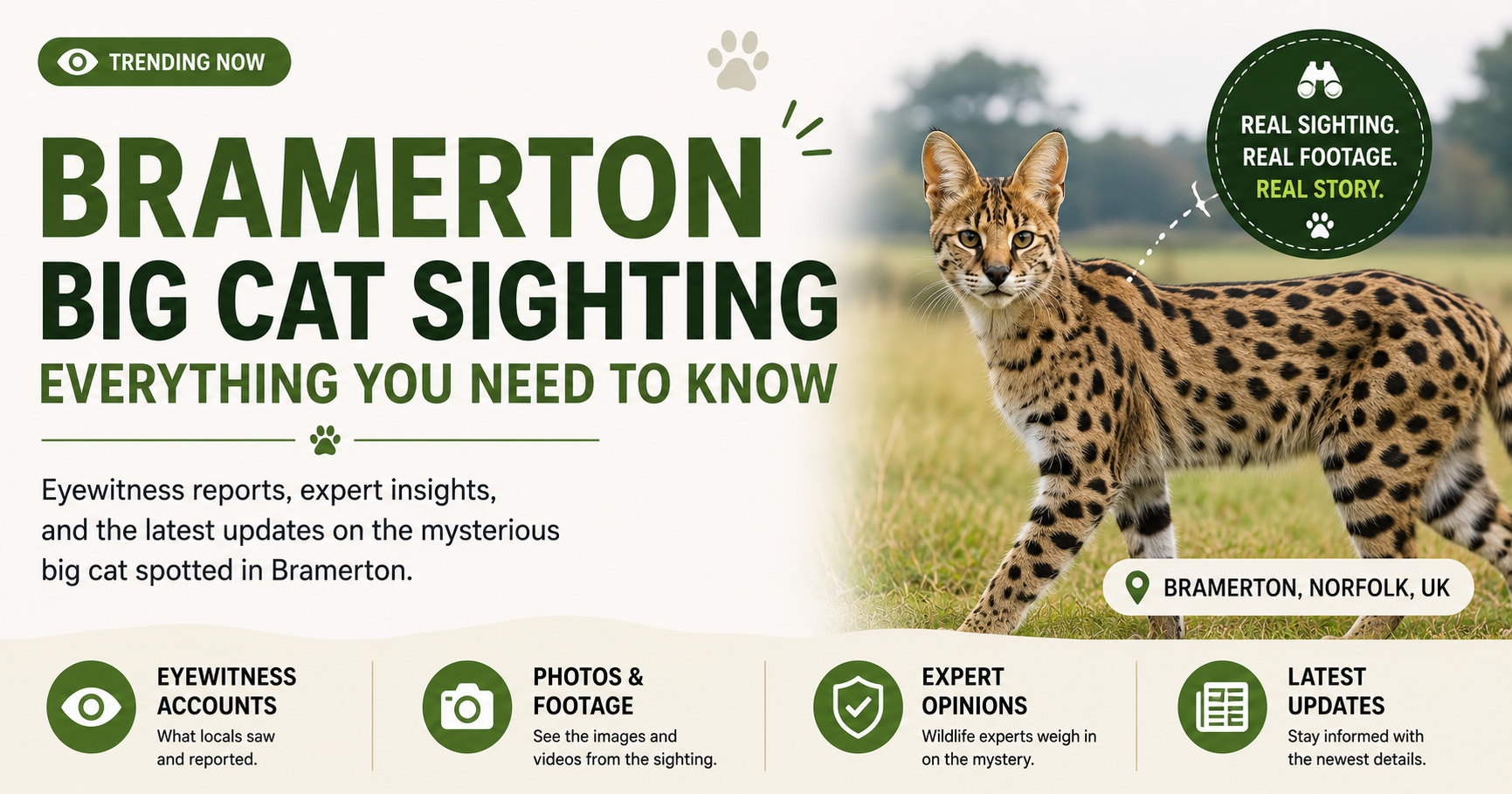
Bramerton Big Cat Sighting 2026: Serval or Savannah Cat Spotted in Norfolk?
I’ve been following UK “big cat” sightings for years — partly out of genuine curiosity, partly because my mum lives in rural Norfolk and loves to forward me every slightly unusual local news story. So when a proper, credible sighting popped up right on her doorstep this week, I sat up and paid attention.
This one is different from the usual grainy-photo-of-a-black-smudge-in-a-field stories. A large spotted cat — described as resembling a “small leopard” — was spotted prowling fields near Bramerton, a quiet village just outside Norwich. And unlike most of these stories, there’s a real eyewitness account, real footage, and a credible explanation for where it might have come from.
Here’s everything that’s happened, what the animal likely is, and what it actually means for anyone living nearby or walking their dog in the area.
What Happened at Bramerton?
On Tuesday evening (24 June 2026), a man named Tom Baker was out walking his dog with his girlfriend near Bramerton when they spotted something unusual in a nearby field.
His first instinct? Fox. Big one, maybe.
But when they zoomed in on their phone camera, the picture changed fast. The animal was spotted, long-legged, and noticeably larger than any domestic cat. “Originally we thought it was a big fox, but we zoomed in on our camera and thought it looked like a leopard,” Baker told the BBC. “It was a lot larger than a normal cat.”
Sensibly, they didn’t try to investigate. They turned around, kept the dog firmly on the lead, and walked away. Baker later described it as “surprising” — which feels like something of an understatement.
The sighting was reported to the RSPCA, which confirmed it had not received any reports of an escaped exotic animal in the area — but asked people to stay alert.
Norfolk Police also stated they had not received any reports.
Since then, multiple people have posted on local Facebook groups saying they, too, had spotted something in the area — and several were hoping to track down the owner.
So What Actually Is It?
Here’s where it gets genuinely interesting. This isn’t being treated as a mystery “big cat” out of folklore. Wildlife experts believe the animal is almost certainly a serval or a Savannah cat — and that it likely escaped from an enclosure nearby.
What is a Serval?
A serval is a medium-sized wild cat native to sub-Saharan Africa. They’re striking animals — tall and lean with large ears, golden coats, and distinctive black spots. Think somewhere between a cheetah and a domestic cat, but with the temperament of neither.
They can jump up to three metres high. They run at around 40mph. They’re described as “prolific hunters” — Kevin Murphy from Norfolk Wildlife Rescue, who has been sharing updates on Facebook, put it plainly: “They are more temperamental than average cats.”
In other words, this is not a lost moggy.
What is a Savannah Cat?
A Savannah cat is a hybrid — a cross between a serval and a domestic cat. The breed originated in the United States in the 1980s and has become increasingly popular as an exotic, expensive “designer pet.” They can cost upwards of £10,000–£20,000.
First-generation (F1) Savannah cats are large — the biggest domestic cat breed in the world, in fact. They look dramatically wild, with spotted coats and long limbs. Later generations become progressively more domestic in appearance and behaviour.
Either animal would explain what was seen at Bramerton.
Is This Legal? What Does UK Law Say?
This is where a lot of people get confused — and where the story gets a bit thorny.
In the UK, owning a serval requires a Dangerous Wild Animals (DWA) licence, issued by your local council. The same applies to F1 Savannah cats (first-generation serval hybrids). The DWA licence is not easy to get — you need to demonstrate appropriate housing, meet safety standards, and pay a fee of roughly £200–£500.
However — and this is the bit that surprises most people — later-generation Savannah cats (F2, F3, and beyond) currently do not require a licence. The further removed the cat is from its serval ancestor, the fewer restrictions apply.
This legal grey area has frustrated animal welfare campaigners for years. Organisations like the Wildheart Trust have been running their SERVIVAL campaign since 2021, pushing for a ban on the hybridisation of exotic felids with domestic cats in the UK. They’ve documented a dramatic rise in servals and F1 hybrids being surrendered or rescued — animals that were bought as status pets and quickly became unmanageable.
The RSPCA’s senior scientific officer, Evie Button, made the welfare argument clearly in relation to the Bramerton sighting: servals are wild animals, and their needs are essentially no different to the same species living in the wild. “Some species — like servals — are unsuitable to be kept as pets because their needs are too complex to be met in a household environment.”
The exotic pet trade has a real human cost for the animals involved, and Bramerton is a live example of why.
Should You Be Worried If You’re in the Area?
Honestly? Not panicking-worried — but sensibly cautious.
Murphy from Norfolk Wildlife Rescue was clear: “To have one roaming about is a bit of a worry, but these things happen.” His advice was directed at the owner: check your enclosure and secure it.
For everyone else, the practical guidance is pretty simple:
If you’re walking in the Bramerton area right now:
- Keep dogs on leads — especially smaller breeds. A serval is a prolific hunter and an unleashed dog could trigger a chase response.
- Don’t approach the animal if you see it. Admire it from a distance, then leave.
- Take a photo or video if it’s safe to do so — this helps experts identify the animal and track its movements.
- Report the sighting. The RSPCA helpline is 0300 1234 999. You can also contact Norfolk Police on 101 if you believe there’s a public safety concern.
- Don’t try to feed, corner, or capture it. Seriously. A serval that feels threatened is not a cat you want to be close to.
It’s worth noting that while servals are not in the league of lions or tigers in terms of danger, they’re still wild animals that can scratch and bite badly. Norfolk Wildlife Rescue described them as “more temperamental than average cats” — and the average cat is already fully capable of drawing blood.
Common Mistakes People Make With These Stories
I’ve seen a few takes on this story online already that are worth addressing.
“This is probably just a big domestic cat.” Unlikely in this case. Baker has footage, was close enough to zoom in clearly, and described it in specific terms. Wildlife experts looking at the footage believe it’s consistent with a serval or Savannah cat. Tom Baker himself said he’d “never seen anything like it around here.” He’d presumably seen large domestic cats before.
“Norfolk is full of big cat sightings, this is probably nothing.” You’re right that the UK has a long history of phantom “big cat” sightings — alleged panthers and pumas spotted from a distance that often turn out to be misidentified domestic cats or optical illusions. But this sighting is categorically different. Wildlife experts have specifically identified this as consistent with a serval or Savannah cat, with the working theory being an escaped pet — not a mythical breeding population in the Norfolk Broads.
“The owner should just be reported and prosecuted.” If the animal turns out to be a licensed serval or a later-generation Savannah cat that doesn’t legally require a licence, the owner may technically not be breaking the law. The issue is a gap in legislation — not necessarily individual wrongdoing. That said, Murphy’s point stands: anyone keeping such an animal has a duty to make sure enclosures are secure.
“I should try to catch it and return it.” Please don’t. This applies even if you mean well.
What Happens Next?
The RSPCA and Norfolk Wildlife Rescue are both monitoring the situation and appealing for information. Local Facebook groups in the area are already buzzing, and at least a handful of additional sightings have been reported since Tuesday evening.
If the animal is indeed an escaped pet — which experts believe is the most likely explanation — the owner may well come forward once they realise it’s missing. That’s what Norfolk Wildlife Rescue is hoping for.
If no owner is identified, this could become a more complex situation. Servals can survive in the English countryside for a while — they’re adaptable hunters — but they’re not suited to the British climate long-term, and the welfare concern swings back to the animal itself.
It’s a story that’s easy to frame as exciting or dramatic. And it is, a bit — it’s not every Tuesday you spot something resembling a leopard in Norfolk. But underneath the novelty, it’s really a story about what happens when exotic pet ownership goes wrong, and about the gap between what UK law allows and what animal welfare organisations have been saying for years needs to change.
A Quick Note on the Broader Picture
The Bramerton sighting fits into a pattern that’s been building for a while. The RSPCA, the Born Free Foundation, and the Wildheart Trust have all flagged an increase in abandoned exotic cats in the UK. The pandemic pet boom led to a surge in unusual animal ownership — and a subsequent wave of animals being surrendered when owners couldn’t cope.
A 2,000% increase in rescued exotic cats including servals and Savannah cats was reported by animal protection organisations in Europe in recent years. That’s not a niche problem. It’s a systemic one.
The UK’s current licensing framework — which leaves later-generation hybrids largely unregulated — is increasingly looking like it needs updating. Campaigners have been pushing for legislative changes for years. Stories like Bramerton tend to be the thing that pushes public awareness enough to matter.
If you’re in Norfolk, stay alert but don’t stress. If you see the cat, report it rather than trying to intervene. And if you’re the owner — please check your enclosure and come forward. The animal deserves to be safe, and so do the people and dogs out enjoying the summer evenings near Bramerton.
Last updated: 26 June 2026. Based on reporting by BBC Norfolk and statements from the RSPCA and Norfolk Wildlife Rescue.
FAQs
Which large wild cat was spotted at Bramerton?
The animal spotted near Bramerton is believed to be either a serval — a medium-sized wild cat native to Africa, with a distinctive spotted coat, long legs, and oversized ears — or a Savannah cat, which is a hybrid breed created by crossing a serval with a domestic cat. Wildlife experts who reviewed the footage think it most likely escaped from a nearby enclosure, which is the most plausible explanation given how these animals end up in the English countryside.
Is there DNA evidence of big cats in the UK?
Yes, and it’s more solid than most people realise. In 2024, DNA from a big cat belonging to the Panthera genus — most likely a leopard — was identified from a swab taken from a dead sheep in the Lake District, marking the first time big cat DNA was confirmed on a carcass in the UK. Before that, a 2023 documentary recovered black hairs from a barbed wire fence on a Gloucestershire farm where sheep had been attacked, and forensic scientists confirmed a 99% DNA match to a big cat species, widely believed to be a black leopard.
Did England ever have big cats?
Absolutely — and not that long ago in geological terms. Around 200,000 years ago, cave lions, leopards, and even jaguars roamed what is now Britain, and lynxes are known to have survived here well into the early medieval period. Lynxes definitely survived in Britain until the 1st century AD, and may have persisted as late as the 6th or 7th centuries. So when people talk about big cats in Britain, they’re not inventing something alien to the landscape — these animals have deep roots here.
What is the Panther DNA in the Lake District?
The Lake District DNA find came from a swab taken from a sheep carcass discovered by a local resident in October 2023. Analysis at a University of Warwick lab run by Professor Robin Allaby confirmed it belonged to an animal in the Panthera genus — the same family as leopards and jaguars. Allaby himself admitted the result made him a believer: “It makes me a convert to the existence of non-native big cats in the UK. Until now, I have remained open-minded — I think that’s my job as a scientist.”
Have black panthers been spotted in the UK?
They’ve been reported for decades, and some of those reports are now backed by evidence. Police logs from Devon and Cornwall between 2021 and 2025 consistently describe large, muscular black cats with long tails, with witnesses using terms like “panther-like” or “lion-sized.” The leading theory for how they got here is straightforward: experts have long suspected that the 1976 Dangerous Wild Animals Act — which forced exotic pet owners to obtain licences — led to a wave of big cats being quietly released into the countryside, with sightings surging in the years that followed.
