My dog Bruno turned 8 last spring, and honestly? I didn’t even realize he was a senior until our vet said it out loud during his checkup.
“He’s doing great — but we should start thinking about his diet differently now that he’s in his senior Dog years.”
I remember sitting there thinking, he seems completely fine though? He still gets excited for walks. Still demolishes his food in 30 seconds flat. Still tries to steal socks.
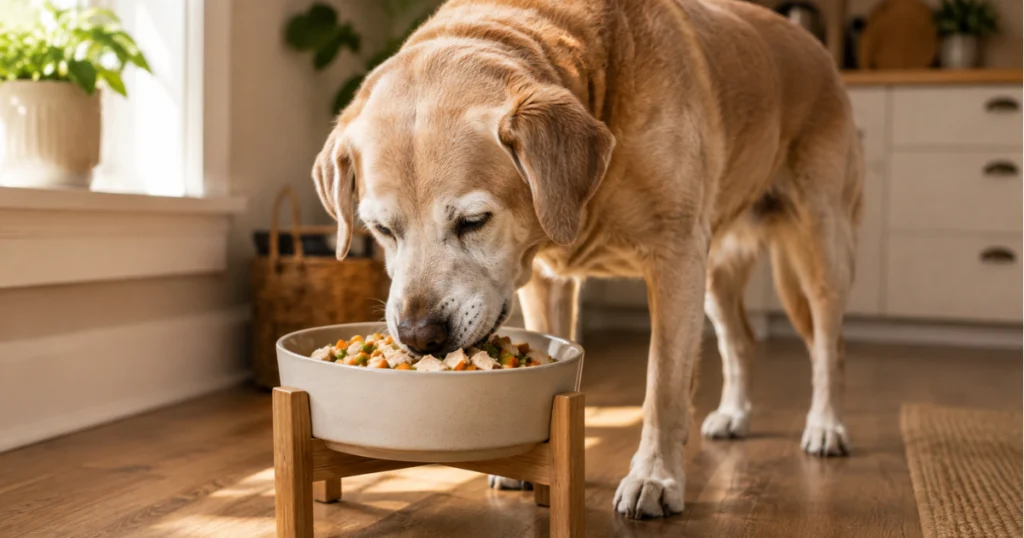
But she was right. Over the next few months, I started noticing small things. He’d take a few extra seconds to get up from his bed in the morning. His coat wasn’t as shiny as it used to be. And he’d started leaving food in his bowl — which Bruno had literally never done in 8 years.
That vet visit sent me down a rabbit hole of research, label-reading, and honestly a few expensive mistakes before I figured out what actually works. If your dog is getting up there in age, here’s everything I learned about best food for senior dogs — so you don’t have to do it the hard way.
When Is a Dog Actually “Senior”?
This tripped me up at first because I assumed senior meant old. Like, visibly slowing down, grey all over, that kind of thing.
Turns out it’s more about breed size than anything else:
- Small breeds (under 20 lbs) — senior from around 10–12 years
- Medium breeds (20–50 lbs) — senior from around 8–10 years
- Large breeds (50–90 lbs) — senior from around 7–8 years
- Giant breeds (90 lbs+) — senior as early as 5–6 years
Bruno is a large-breed mix, so 8 years put him squarely in senior territory even though he didn’t look or act like what I pictured when I heard that word.
The reason giant breeds age faster is just physics — bigger bodies put more strain on joints, hearts, and organs over time. A 6-year-old Great Dane has genuinely lived a harder life, physiologically speaking, than a 6-year-old Beagle.
So if you’ve got a big dog and you’re thinking “he’s only 7, he’s fine” — worth double-checking with your vet.
How Their Nutritional Needs Actually Change
This is the part that surprised me the most, because some of it is the exact opposite of what I assumed.
Protein needs go UP — not down
My first instinct was to go easier on protein as Bruno aged. Less strain on his system, right? Nope. Older dogs actually become less efficient at processing protein, which means they need more of it to maintain the same muscle mass.
This is called sarcopenia — age-related muscle loss — and it’s one of the most common problems in senior dogs that owners don’t notice until it’s already significant. A dog that looks “skinny for his age” is often just protein-deficient.
I switched Bruno to a food with around 26–28% protein (dry matter basis) and within a month his muscle definition visibly improved. Small change, big difference.
Calories need to come down
Here’s where the balance comes in. Less activity + slower metabolism = fewer calories needed overall. Most senior dogs need roughly 20–30% fewer calories than they did in their prime. But — and this is important — you cut calories by reducing fat and fillers, not protein.
Fiber becomes more important
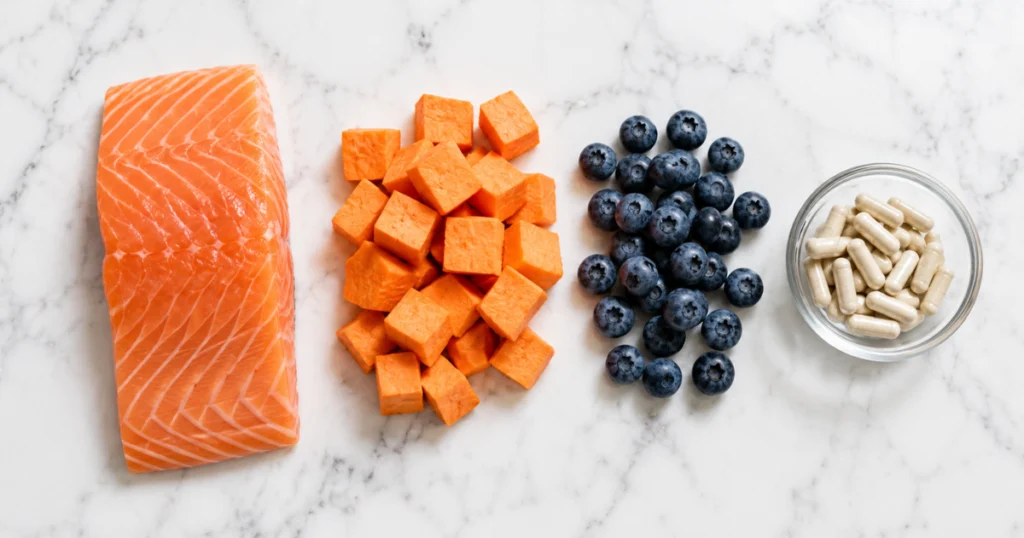
Digestion slows down with age. Bruno started having inconsistent stools around the same time everything else shifted, and increasing dietary fiber (through food, not supplements) sorted it out within two weeks. Sweet potato, pumpkin, and brown rice are your friends here.
Joint support goes from optional to essential
Glucosamine and chondroitin aren’t just for dogs that are visibly limping. By the time you see obvious joint problems, the deterioration has usually been happening quietly for a while. A food that includes these — or a daily supplement — is worth starting early.
Omega-3 fatty acids
Fish oil became a non-negotiable for Bruno. It supports joints, brain function, and coat condition all at once. His coat went from dull and slightly flaky back to the soft, shiny version within about 6 weeks of consistent omega-3 supplementation.
For a full breakdown of canine nutrition fundamentals, our complete dog nutrition guide covers all the building blocks — this post just goes deeper on the senior-specific piece.
Signs the Current Food Isn’t Working

I ignored some of these for longer than I should have, because each one on its own seemed minor. But they add up.
Weight gain without eating more. Bruno put on about half a kilo over three months without any change in portions or activity. That’s a metabolism shift — his food’s calorie density was too high for where he was now.
Muscle loss despite normal eating. This is sneaky because a dog can look “normal” weight while actually losing muscle and replacing it with fat. Run your hands along their spine and ribs — you should feel them easily, but not see them prominently.
Stiffness getting up, especially in the morning. Cold, stiff joints after sleep improved noticeably for Bruno once I added omega-3s and glucosamine.
Coat going dull or dry. Nearly always a fat quality issue, not a grooming issue.
Leaving food in the bowl. For Bruno this was the alarm bell. Dogs who’ve always been enthusiastic eaters don’t suddenly go off their food without reason. It can be dental pain (hard kibble gets uncomfortable for older dogs), boredom with the same food, or the food genuinely not agreeing with them anymore.
Frequent gas or soft stool. Their gut is less resilient now. What they tolerated fine at 3 might not sit as well at 9.
Reading the Label Without Losing Your Mind
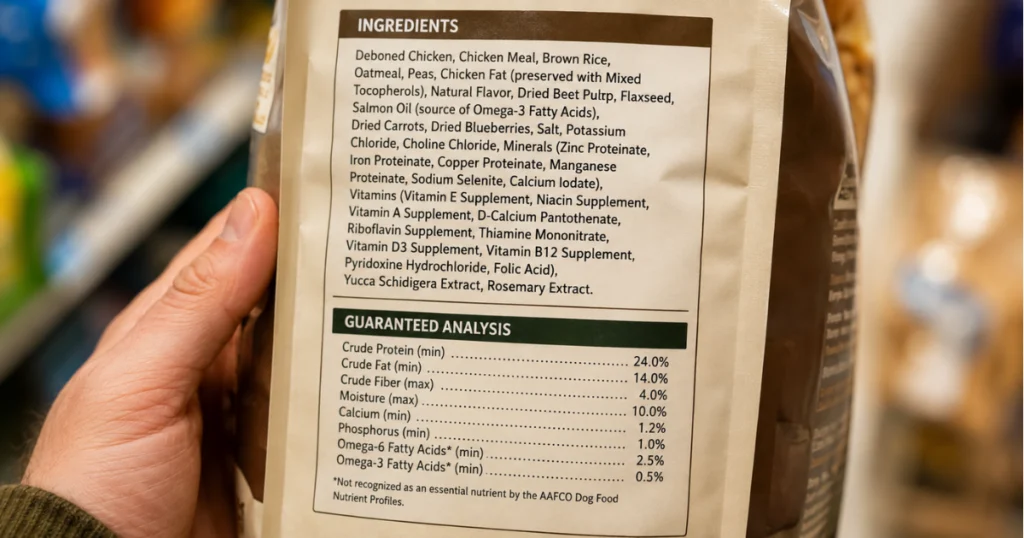
Pet food marketing is genuinely designed to confuse you. Here’s what actually matters:
AAFCO statement. There’s no regulated “senior” category in pet food — so “senior formula” on the front means nothing legally. What matters is the AAFCO statement, usually printed small near the bottom: “formulated to meet the nutritional levels established by the AAFCO Dog Food Nutrient Profiles for adult maintenance.” That’s your baseline.
First ingredient is a named animal protein. Chicken, salmon, turkey, beef — not “poultry by-product,” not “meat meal” of unspecified origin. Named protein = quality protein.
Omega-3 source in the ingredient list. Fish oil, salmon oil, or flaxseed. If you can’t find it, the food doesn’t have meaningful omega-3 content.
Glucosamine and chondroitin. Some senior foods include these, some don’t. Check the guaranteed analysis panel for mg per serving — you’re looking for 500mg+ of glucosamine to be worth anything.
Sodium levels. Senior dogs are more prone to heart and kidney issues. Avoid foods where salt appears near the top of the ingredient list, especially in wet foods.
I went through probably six different foods before landing on one that hit all of these. Our top 5 healthiest dog foods review breaks down specific options that meet these criteria — saved me a lot of label-squinting.
Homemade Food for Senior Dogs: Is It Worth It?
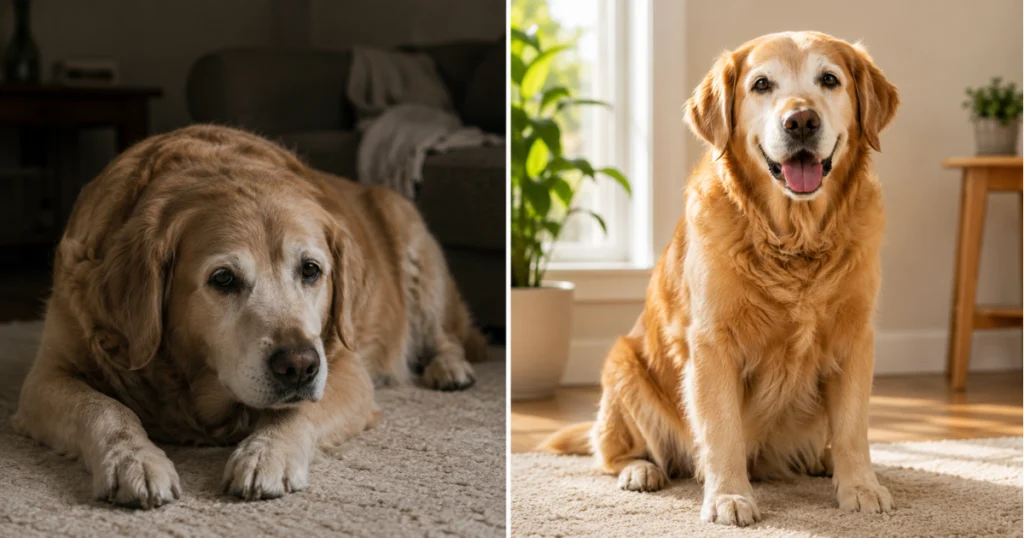
Honestly, yes — with the right approach.
After Bruno started being fussier with commercial food, I started making one homemade meal a day and feeding commercial food for the other. It made a real difference in his appetite and his coat.
The basics for a senior homemade meal:
Every meal needs an animal protein base. Cooked chicken thighs, ground turkey, salmon, scrambled eggs. Bruno gets chicken most days with one salmon meal per week for the omega-3 boost.
Add a soft, easy-to-digest carb. Sweet potato, well-cooked brown rice, or plain pumpkin puree. Nothing hard or raw for older digestive systems.
Include a joint-support element. I stir a glucosamine supplement into Bruno’s food directly, but unsalted bone broth is also a great addition — he finds it irresistible and it encourages eating on days his appetite is lower.
Keep it soft. If your senior dog is reluctant about dry kibble, warm the homemade food slightly or add a splash of warm water. The smell intensifies and most older dogs go for it immediately.
Our homemade dog food recipes are a solid starting point — for senior dogs specifically, lean toward the lower-fat, higher-protein recipes and add your glucosamine supplement separately.
One real caveat: get at least one recipe reviewed by your vet before going fully homemade for a senior dog. They have less nutritional margin for error than younger adults.
Portion Control and Feeding Schedule
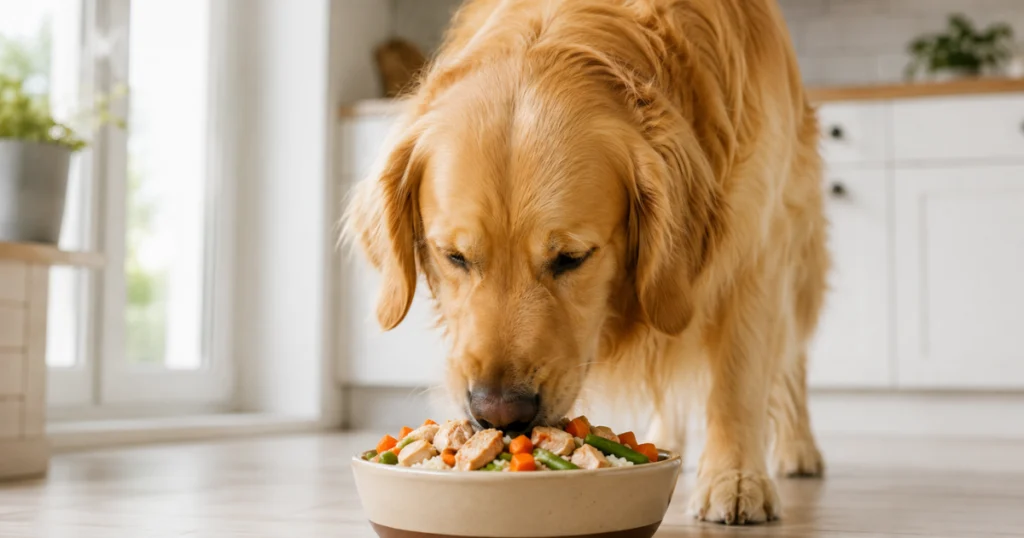
Bruno now gets three smaller meals a day instead of two larger ones. This was one of the simplest changes with the biggest impact on his digestion and energy levels.
Older digestive systems genuinely handle smaller, more frequent meals better. It also reduces bloat risk — which is a real concern for large and giant breeds as they age.
For actual amounts: start with the feeding guide on your food’s packaging, then adjust based on body condition rather than weight alone. The check I use:
- Run hands along the spine — can you feel vertebrae without pressing hard? Good.
- Feel the ribs from the side — easily felt but not visible? Good.
- Look from above — is there a visible waist? Good.
- Look from the side — slight upward tuck of the abdomen? Good.
If all four check out, you’re in the right range. Adjust by 10% increments and wait 2–3 weeks to see the effect before adjusting again.
If you’re someone who works full days and worries about your dog’s routine, our guide to taking care of a dog when you work has practical tips on scheduling — senior dogs especially thrive on predictable feeding times.
7-Day Food Transition Plan
Do not skip this step. Older dogs get digestive upset far more easily than younger ones, and switching cold turkey is a recipe for a very unhappy week for both of you.
| Day | Old Food | New Food |
| 1–2 | 75% | 25% |
| 3–4 | 50% | 50% |
| 5–6 | 25% | 75% |
| 7 | 0% | 100% |
If you notice soft stool, gas, or vomiting at any stage — pause and extend that phase by two more days before moving forward. Some senior dogs need a full 14-day transition rather than 7. Bruno needed 10 days. No rush.
Common Mistakes I Made (So You Don’t Have To)
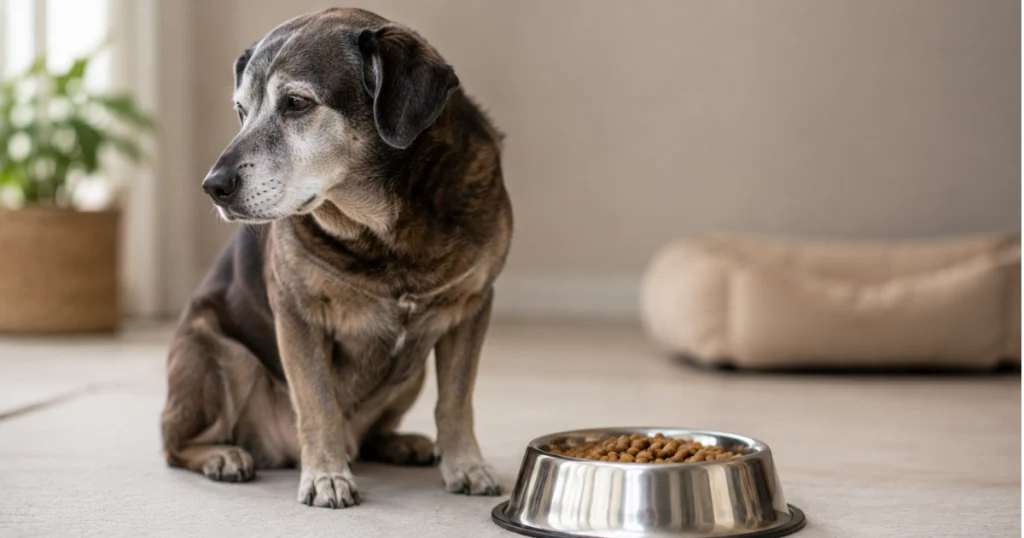
Cutting protein to “go easier” on aging kidneys. Unless your dog has a diagnosed kidney condition and your vet has specifically recommended low protein, this usually backfires. Muscle loss follows.
Buying “senior” labeled food without checking the label. The word “senior” is marketing, not regulation. I paid a premium for two different “senior” formulas that were nutritionally almost identical to their regular adult versions.
Switching too fast. Did this once out of impatience. Three days of soft stool. Lesson learned.
Ignoring appetite changes. “He’ll eat when he’s hungry” doesn’t apply the same way to senior dogs. Persistent appetite loss is worth investigating — it can signal dental pain, nausea, or underlying health issues.
Forgetting water. Sounds obvious, but senior dogs are more prone to dehydration and kidney stress. Bruno gets a splash of low-sodium broth added to his water bowl most days. He drinks more consistently, and his kidneys thank him.
Frequently Asked Questions
When should I actually switch to senior food?
For most breeds, around 7 years. For giant breeds, closer to 5–6. But watch your dog’s body condition and energy rather than going purely by age — some dogs show the signs earlier, some later.
Is “senior formula” dog food actually different?
Sometimes yes, sometimes it’s just rebranded adult food. Check the protein percentage, whether joint-support ingredients are included, and the calorie density. The label on the back matters more than the claim on the front.
My senior dog suddenly doesn’t want to eat — what do I do?
Try warming the food slightly, switching to wet food, or adding low-sodium broth. If appetite loss persists more than 48 hours, see your vet — it can be dental pain, nausea, or something internal worth checking.
Can I feed my senior dog homemade food full-time?
Yes, but get your recipe reviewed by a vet first. Senior dogs are less forgiving of nutritional gaps than younger dogs, and calcium/phosphorus balance in particular is easy to get wrong without guidance.
Do senior dogs need supplements?
Omega-3 fish oil and glucosamine/chondroitin are the two most broadly useful ones. Beyond that, it depends on the individual dog — talk to your vet before stacking multiple supplements.
One Last Thing
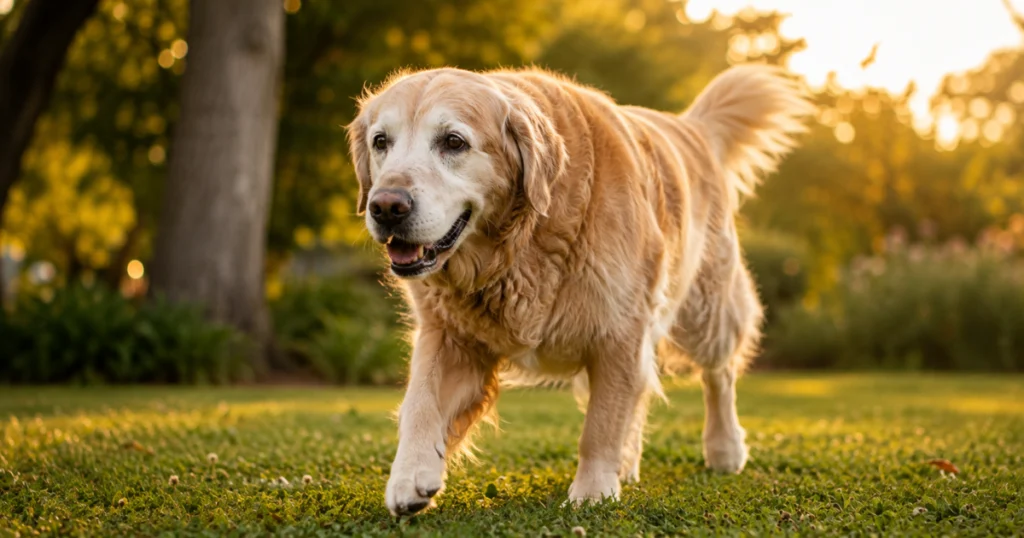
The biggest shift for me wasn’t any single food change — it was paying closer attention. Bruno told me things were off before I consciously registered it. The bowl he left half-full. The extra few seconds getting up. The coat that lost its shine.
Senior dogs can’t tell you when something’s wrong. But they show you, if you’re watching.
Get the nutrition right, and most of those signs reverse faster than you’d expect. Bruno’s back to finishing his bowl every time, his coat is better than it was at 5, and he still tries to steal socks.
For the full picture on canine nutrition across every life stage, our complete dog nutrition guide is the place to start.