
I’ve cleaned up more messes than I care to count.
My Beagle mix, Mochi, has had a sensitive stomach since she was about two years old. Not in a dramatic, emergency-vet way — more in a “why is her stomach making that noise again” and “not another soft stool” kind of way. Chronic, low-grade digestive upset that just became part of our routine.
For two years I assumed it was just her personality. Some dogs are just gassy, right?
Wrong. It was her food. And the frustrating part is that the food was a well-known brand, decently priced, with a label full of words that sounded healthy. It took a lot of trial and error — and one very helpful vet appointment — to figure out what was actually going on and what to do about it.
If your dog’s stomach is a constant source of stress, this is everything I learned about which is the best dog food for sensitive stomach.
First — What Does “Sensitive Stomach” Actually Mean?
It sounds vague because it is. “Sensitive stomach” isn’t a diagnosis — it’s a catch-all for a bunch of different things that all show up the same way: digestive discomfort.
The root cause matters a lot, because the fix is different depending on what’s actually going on:
Food intolerance — the digestive system struggles to break down a specific ingredient. Common culprits are certain proteins (chicken is surprisingly frequent), dairy, wheat, soy, and artificial additives. This isn’t the same as an allergy — it’s more like your dog’s gut just doesn’t handle that ingredient well.
Food allergy — an immune system response to a specific protein. Usually shows up as a combination of digestive AND skin symptoms (itching, ear infections, paw licking alongside stomach issues).
Poor ingredient quality — highly processed ingredients, excessive fillers, and artificial preservatives are harder to digest for sensitive systems even without a specific intolerance.
Eating too fast — some dogs just inhale their food and pay for it later. Slow feeder bowls exist for this reason.
Sudden food changes — the gut microbiome needs time to adjust to new food. Switching cold turkey is one of the most common causes of temporary digestive upset that owners mistakenly blame on the new food.
Mochi’s issue turned out to be a combination of chicken intolerance and low fiber content in her old food. Once I understood that, fixing it got a lot simpler.
Signs Your Dog Has a Sensitive Stomach

Some of these are obvious. Some I ignored for way too long thinking they were just “her thing.”
- Loose stool or diarrhea that comes and goes without an obvious cause
- Excessive gas — and I mean the kind that clears a room
- Vomiting, especially after meals or shortly after eating
- Gurgling stomach sounds (borborygmi — yes, that’s the actual word)
- Grass eating, which dogs often do to soothe an upset stomach
- Loss of appetite on and off
- Bloated or visibly uncomfortable belly after eating
- Eating fine but never seeming to thrive — dull coat, low energy, not maintaining good weight
If you’re seeing three or more of these regularly, it’s worth taking seriously rather than normalizing it. A vet visit is worth it just to rule out anything more serious — parasites, inflammatory bowel disease, and pancreatic issues can all look like “sensitive stomach” on the surface.
What to Look for in a Dog Food for Sensitive Stomachs
This is where I spent most of my research time, and where most owners go wrong by focusing on the wrong things.
Limited ingredient formulas
The shorter the ingredient list, the easier it is to identify what’s causing problems — and to rule things out. Limited ingredient diets (LID) typically feature one protein source and one carbohydrate source, which makes them genuinely useful for dogs with sensitivities.
Mochi’s current food has five main ingredients. Her old food had twenty-three. The difference in her digestion was noticeable within ten days.
Novel proteins
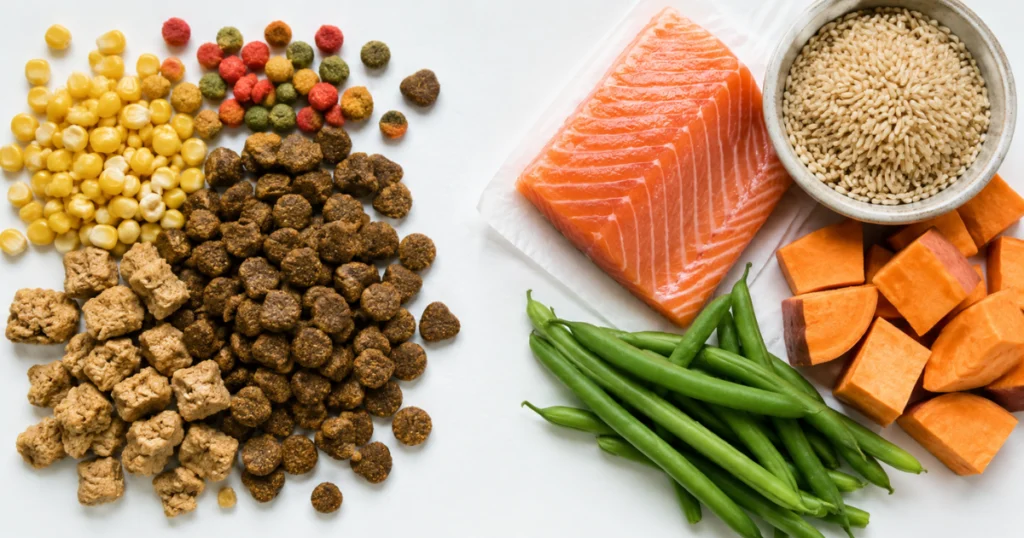
If your dog has been eating chicken their whole life and keeps having stomach issues, chicken might be the problem. Novel proteins — ones your dog hasn’t eaten before — are less likely to trigger an established intolerance. Duck, venison, rabbit, kangaroo, and salmon are all common novel protein choices.
Mochi switched to salmon as her primary protein and it was genuinely transformative. Her stool normalized within two weeks.
Highly digestible carbohydrates
Sweet potato, pumpkin, brown rice, and oatmeal are easier on sensitive digestive systems than corn, wheat, or soy. They also provide the fiber that helps regulate gut motility — something a lot of sensitive-stomach dogs are missing.
Probiotics and prebiotics
A healthy gut microbiome is the foundation of good digestion. Some sensitive-stomach formulas include live probiotic cultures or prebiotic fiber sources (chicory root, inulin). If your dog’s food doesn’t include these, a daily probiotic supplement is worth trying — the difference can be significant. I use a powder that stirs into Mochi’s food and she doesn’t notice it at all.
No artificial additives
Artificial colors, flavors, and preservatives add processing load that a sensitive gut doesn’t need. They don’t add nutrition and they’re easy to avoid — just check the ingredient list.
Easily digestible fat sources
Fish oil and chicken fat (even if avoiding chicken protein) are generally well-tolerated. Avoid foods where the fat source is vague (“animal fat”) or the fat content is very high for a low-activity dog.
For a full breakdown of what good nutrition looks like across all dog foods, our complete dog nutrition guide is the place to start — this post focuses specifically on the sensitive-stomach piece.
The Elimination Diet: The Most Reliable Way to Find the Problem

This is what my vet recommended when I asked her directly — and it’s the only approach that gives you real answers rather than guesses.
How it works:
You feed your dog a single novel protein + single carbohydrate diet for 8–12 weeks, with absolutely nothing else. No treats, no table scraps, no flavored medications if avoidable. Then you reintroduce ingredients one at a time and watch for reactions.
It’s tedious. It requires discipline. And it’s the only method that actually identifies what your specific dog reacts to — because every dog is different.
Step by step:
Step 1: Choose a protein your dog has never eaten. If they’ve always had chicken and beef, try duck, rabbit, or venison. If they’ve had those too, try kangaroo or crocodile (yes, these exist in pet food).
Step 2: Choose a simple carbohydrate. Sweet potato or plain white rice are the two most common choices for elimination diets — both highly digestible and unlikely to cause reactions.
Step 3: Feed only this combination for 8–12 weeks. This is the hardest part. No treats unless they’re the same protein/carb. No exceptions.
Step 4: Observe and document. Keep a simple notes app log of stool consistency, gas, vomiting frequency, and coat condition. Patterns become very clear over 8 weeks when you’re actually tracking.
Step 5: Reintroduce one ingredient at a time. After the elimination period, add one new ingredient every 2 weeks and watch for reactions. This is how you identify specific triggers.
Mochi’s elimination diet identified chicken and certain grains as her triggers. She’s been on a salmon and sweet potato base ever since and I can count her bad stomach days on one hand.
Homemade Food for Sensitive Stomachs
Sometimes commercial food — even limited ingredient formulas — still contains enough variables to cause issues. That’s when homemade meals become worth the extra effort.
For sensitive stomach dogs, homemade works well because you control every single ingredient. No hidden additives, no mystery “natural flavors,” no cross-contamination from shared manufacturing facilities.
A simple sensitive stomach homemade formula:
- Protein (50%): Boiled or baked salmon, duck, or turkey — whichever novel protein works for your dog. No seasoning, no oil.
- Carbohydrate (25%): Well-cooked sweet potato or plain white rice. Both are gentle on inflamed digestive systems.
- Vegetables (20%): Steamed pumpkin, cooked green beans, or plain carrots. All easy to digest and high in fiber.
- Supplement (5%): A calcium source (ground eggshell or a supplement) and a probiotic. Homemade diets need calcium supplementation or the calcium/phosphorus balance gets off.
Our homemade dog food recipes have several recipes that adapt well for sensitive stomachs — look for the lower-fat, single-protein options and swap the protein for whatever your dog tolerates.
Wet Food vs. Dry Food for Sensitive Stomachs
This comes up a lot and the answer is: it depends on the dog.
Wet food is generally easier to digest because of its higher moisture content and softer texture. It’s often more palatable for dogs who’ve gone off dry food due to stomach discomfort. The downside is cost and dental hygiene — wet food doesn’t provide the abrasion that helps keep teeth cleaner.
Dry food (kibble) is more practical and more affordable, and many dogs with sensitive stomachs do fine on high-quality limited ingredient kibble. The key is digestibility of ingredients, not the format.
A mixed approach works well for many sensitive-stomach dogs — a base of high-quality kibble with a small amount of wet food mixed in. The wet food increases moisture, improves palatability, and adds some digestive ease without the full cost of feeding wet exclusively.
Mochi gets kibble with a spoonful of wet food mixed in twice a day. Her digestion is more consistent than it’s ever been.
Feeding Practices That Make a Difference

The food itself matters, but how you feed matters almost as much for sensitive-stomach dogs.
Slow feeder bowls. If your dog eats fast — head down, bowl empty in 30 seconds — a slow feeder bowl is worth trying before anything else. Eating too fast means swallowing air, which causes bloating and gas that has nothing to do with the food itself. A puzzle-style feeder cut Mochi’s eating time from 25 seconds to about 4 minutes. The difference in post-meal gurgling was immediate.
Consistent feeding schedule. Sensitive digestive systems do better with predictability. Two meals at the same times every day creates a digestive rhythm. Irregular feeding — skipping meals, feeding at different times — can trigger symptoms on its own. If your schedule is unpredictable, our guide on caring for a dog when you work has practical tips on keeping routines consistent around a busy day.
Smaller, more frequent meals. Instead of two larger meals, try three smaller ones. Less volume per meal = less digestive load per session. This made a noticeable difference for Mochi during the transition period.
Room temperature food. Cold food straight from the fridge can trigger stomach cramps in sensitive dogs. Let refrigerated food sit for 20–30 minutes before serving, or add a small splash of warm water to bring it to room temperature.
No table scraps. I know. It’s hard. But for sensitive-stomach dogs, even small amounts of human food — especially anything fatty, spiced, or dairy-based — can undo a week of careful feeding. Strict no-scraps during the investigation phase, and limited, intentional treats after you know what your dog tolerates.
The Transition: How to Switch Without Making Things Worse
Switching to a new food is the right move — but do it wrong and you’ll blame the new food for problems the switch itself caused.
10-day transition for sensitive stomachs (slower than the standard 7-day):
| Day | Old Food | New Food |
| 1–3 | 80% | 20% |
| 4–6 | 60% | 40% |
| 7–8 | 40% | 60% |
| 9–10 | 20% | 80% |
| 11+ | 0% | 100% |
If at any point you see a flare-up — loose stool, vomiting, excessive gas — go back one stage and hold it there for an extra 3 days before moving forward. Don’t abandon the new food because of transition symptoms unless the reaction is severe.
Adding a probiotic supplement during the transition period helps the gut microbiome adjust faster. I used a powdered probiotic for the first 3 weeks of Mochi’s switch and had zero transition issues.
Mistakes I Made That Set Us Back
Switching foods too often. Every time Mochi had a bad stomach day on a new food, I’d panic and switch again. This meant she was constantly in transition-induced upset, and I could never tell if the food was the actual problem. Commit to 4 weeks minimum before concluding a food doesn’t work.
Trusting the “sensitive stomach” label. Several commercial foods market themselves as “sensitive stomach” formulas while still containing the exact ingredients that cause problems for most sensitive dogs. Chicken is the most common — loads of “sensitive stomach” formulas still use chicken as the primary protein. Read the ingredient list, not the front of the bag.
Giving too many treats during the elimination diet. Even “healthy” treats can contain the ingredient you’re trying to eliminate. I accidentally fed Mochi chicken-based treats for the first three weeks of her duck elimination diet and got no useful data at all.
Not tracking anything. Memory is unreliable over 8 weeks. A simple daily note — stool consistency (1–5 scale), any vomiting, gas level — makes patterns obvious that you’d otherwise miss. The Notes app on your phone is enough.
Assuming it was behavioral. For a long time I thought Mochi was just anxious. Anxious dogs do get upset stomachs — but anxiety was a symptom of her discomfort, not the cause. Fixing the food fixed the anxiety too.
Frequently Asked Questions
How do I know if my dog has a sensitive stomach or something more serious?
Occasional digestive upset is normal. If symptoms are chronic (happening multiple times a week), getting worse over time, or accompanied by blood in stool, significant weight loss, or extreme lethargy — see a vet. Sensitive stomach is a diagnosis of exclusion, meaning other causes need to be ruled out first.
What’s the single best protein for a sensitive stomach dog?
There’s no universal answer — it depends on what your dog tolerates. Salmon and turkey are generally well-tolerated by most sensitive-stomach dogs. Novel proteins (duck, venison, rabbit) are the safest bet if you don’t know your dog’s specific triggers yet.
How long does it take to see improvement after switching food?
Most owners see meaningful improvement within 2–4 weeks of switching to a better-suited food. Full gut microbiome adjustment can take 6–8 weeks. If you see zero improvement after 8 weeks on a new limited-ingredient food, that food likely isn’t the right fit either.
Is grain-free food better for sensitive stomachs?
Not automatically. Grains aren’t the problem for most sensitive-stomach dogs — specific proteins and low-quality fillers usually are. Some dogs do better without grains, but grain-free isn’t a magic fix. Focus on ingredient quality and simplicity over the grain-free label.
Can I just cook for my dog instead of buying special food? Yes — and for dogs with complex sensitivities, homemade food can be the most reliable solution. The key is nutritional completeness — you need a calcium source and ideally a vet or veterinary nutritionist to review the recipe, especially for long-term feeding.
My dog has a sensitive stomach AND food allergies. What do I do?
These often overlap. Work with your vet to do a proper elimination diet — it addresses both simultaneously by starting from a clean slate. Once you know the triggers, you can find a commercial food that avoids them, or go homemade. Our complete dog nutrition guide covers the full nutrition picture that helps you make sense of these decisions.
Are probiotics actually worth it for sensitive stomach dogs?
In my experience, yes. The research is still developing, but the practical results for many sensitive-stomach dogs (including Mochi) are real. A daily probiotic improved her stool consistency even before I changed her food. They’re low risk, reasonably priced, and worth trying before making more drastic changes.
What Actually Fixed It

If you’re looking for the short version: limited ingredients, novel protein, added fiber, a slow feeder bowl, consistent schedule, and patience.
It took me about four months from “something is wrong” to “this is finally working.” That’s longer than it needed to be because I kept switching too fast and not tracking anything.
The slow feeder bowl alone improved things noticeably. The food switch to salmon and sweet potato did the rest.
Mochi still has the occasional off day — that’s just life with a dog. But the constant background hum of digestive issues is gone, and she’s genuinely more comfortable, more energetic, and a lot more fun to be around.
For anyone starting from scratch on understanding what your dog actually needs nutritionally, our top 5 healthiest dog foods review is a good shortlist of options that meet high ingredient standards — several of them work well for sensitive stomachs too.
Start simple, track everything, and give changes enough time to actually work.