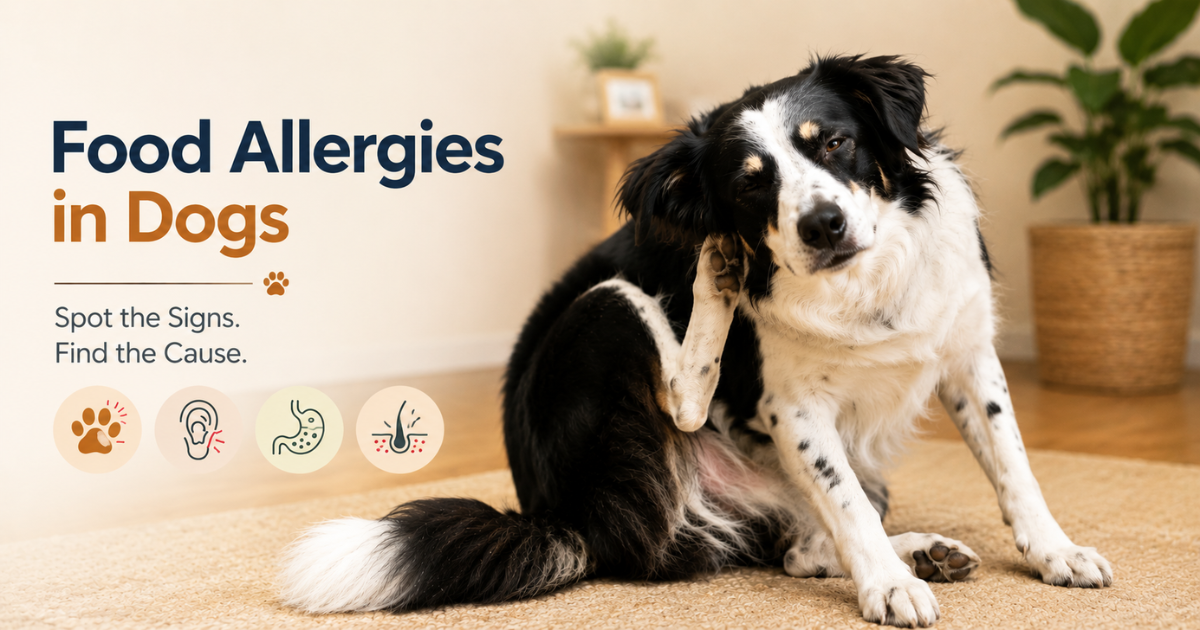
For almost eight months, I thought my dog had a skin condition.
Remy — my three-year-old Border Collie mix — had been itching constantly. Not occasionally, not seasonally. Constantly. He’d wake me up at 2am scratching his ears. He’d chew his paws until they were pink and raw. He got his third ear infection in six months and the vet put him on antibiotics again.
Every vet visit ended the same way. Medicated shampoo. Antihistamines. Sometimes a short course of steroids that worked for two weeks and then wore off. Nobody mentioned food. Not once.
It wasn’t until I switched vets and a new doctor looked at Remy’s full history and said “has anyone ever talked to you about a food trial?” that the penny dropped.
Eight months. Three ear infections. Two rounds of steroids. One very itchy dog.
It was chicken. Remy is allergic to chicken — the protein that had been the first ingredient in his food his entire life.
If your dog food allergies symptoms like skin issues, ear infections, and vet visits that never fully resolve, this is what I wish someone had told me sooner.
Food Allergy vs. Food Intolerance — They’re Not the Same Thing
This confused me for a long time and it’s worth clearing up because the symptoms overlap but the mechanisms are different.
Food intolerance is a digestive issue. The gut struggles to process a specific ingredient — usually showing up as gas, loose stool, vomiting, or general stomach upset. It’s uncomfortable but it’s not an immune response.
Food allergy is an immune system response. The body identifies a specific protein as a threat and mounts a full defensive reaction every time that protein is consumed. This is why the symptoms are often skin and ear-based rather than purely digestive — the immune response affects the whole body, not just the gut.
Remy had almost zero digestive symptoms. His stool was fine. He ate enthusiastically. Everything looked normal from a digestion standpoint. That’s exactly why food was never considered — because most people (and some vets) associate food problems with stomach problems.
The reality is that skin symptoms are the most common sign of food allergies in dogs — not digestive ones. This is the piece of information that changes everything.
The Real Dog Food Allergies Symptoms
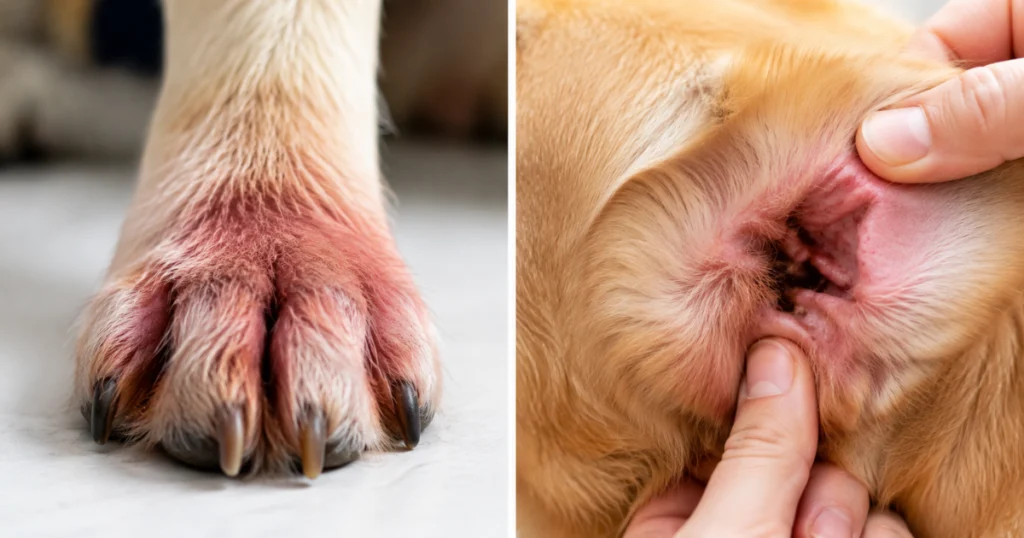
Some of these are obvious. Most of them get misdiagnosed as something else for months.
Skin symptoms:
- Chronic itching — paws, face, ears, armpits, groin, around the tail base
- Red, inflamed, or irritated skin (especially in skin folds)
- Hot spots — localized areas of raw, infected skin from constant scratching or licking
- Hives or raised bumps (less common but possible)
- Thickened or darkened skin in chronically affected areas
- Hair loss from repeated scratching or chewing
Ear symptoms:
- Recurring ear infections — this is one of the biggest red flags and it’s massively underdiagnosed as food-related
- Dark discharge, yeasty smell, head shaking, pawing at ears
- Ear infections that clear up with treatment but come back within weeks or months
Digestive symptoms (present in about 10-30% of food allergy cases):
- Vomiting after meals
- Loose stool or diarrhea
- Increased frequency of bowel movements
- Excessive gas
Other symptoms people miss:
- Chronic paw licking or chewing — paws that are constantly pink or rust-stained (from saliva) are a classic sign
- Rubbing the face on carpet or furniture
- Anal scooting more than occasionally
- Chronic conjunctivitis (goopy eyes) that keeps returning
- General restlessness and poor sleep from constant discomfort
Remy had seven of these. I’d normalized all of them because they’d been present for so long I forgot they weren’t normal.
The Most Common Food Allergy Triggers in Dogs

Here’s the part that surprises most people: it’s almost always the protein, not the grain.
The most common food allergens in dogs, in rough order of frequency:
- Beef — the most common food allergen in dogs overall
- Chicken — extremely common, and extremely common in dog food
- Dairy — often overlooked because owners don’t realize dairy is in many commercial foods
- Wheat/gluten — less common than the grain-free movement suggests, but real
- Egg — underdiagnosed because eggs are often seen as a “healthy” addition
- Soy — common filler in lower-quality foods, can trigger reactions
- Lamb — used to be considered a “safe” novel protein, now common enough to cause reactions in some dogs
- Fish — less common but possible, especially in dogs fed fish-based diets long-term
Notice something? Chicken and beef — the two proteins in the majority of mainstream dog foods — are the top allergens. This is partly because allergens develop through repeated exposure over time. A dog that’s eaten chicken every day for three years is more likely to develop a chicken allergy than a dog that’s only had it occasionally.
This is why novel proteins — ingredients your dog has never eaten before — are the foundation of allergy management.
Food Allergies vs. Environmental Allergies: How to Tell the Difference
This is genuinely difficult, and it’s the main reason food allergies take so long to diagnose. The symptoms can look identical.
Environmental allergies (atopy) are triggered by things like pollen, dust mites, mold, and grass. They tend to be:
- Seasonal (worse at certain times of year)
- Responsive to antihistamines and steroids, at least temporarily
- Associated with outdoor exposure patterns
Food allergies tend to be:
- Year-round, with no seasonal pattern
- Only partially responsive to steroids (they reduce inflammation but the trigger is still present)
- Present regardless of how much or little time the dog spends outside
Remy’s symptoms were identical in January and July. That was actually the clue — atopy tends to have at least some seasonal variation. When symptoms are completely flat across all seasons, food becomes more suspicious.
The honest answer is you can’t definitively distinguish them without a proper elimination diet trial. Allergy blood tests and skin prick tests exist but they have significant false positive and false negative rates for food allergens specifically — most veterinary dermatologists don’t rely on them for food allergy diagnosis. The elimination diet is the gold standard.
The Elimination Diet: The Only Reliable Way to Diagnose Food Allergies

I know this isn’t what people want to hear. An 8–12 week restricted diet sounds tedious and it is. But it’s the only method that actually gives you answers.
Blood tests, saliva tests, hair tests — none of these are validated for diagnosing food allergies in dogs. I wasted money on a saliva test early on that came back with a list of 40 “reactive” foods that turned out to be mostly meaningless. My new vet wasn’t surprised.
Here’s how to run an elimination diet properly:
Step 1: Choose a hydrolyzed or novel protein diet
You have two options:
Novel protein diet: A single protein your dog has never eaten before. If they’ve had chicken, beef, and lamb their whole life, try duck, venison, rabbit, kangaroo, or crocodile. The protein must be genuinely novel — even trace exposure matters.
Hydrolyzed protein diet: Proteins that have been broken down into fragments too small for the immune system to recognize. These are prescription diets (like Royal Canin Hydrolyzed Protein or Purina Pro Plan HA) and they’re the most reliable option if you can’t confirm your dog has never been exposed to certain proteins.
Remy went on a venison and potato limited ingredient diet. No other protein sources, no treats with different proteins, nothing.
Step 2: Eliminate absolutely everything else
This is where most people fail the elimination diet without realizing it.
- No flavored medications (use unflavored where possible)
- No treats unless they’re the same novel protein
- No table scraps, no “just this once”
- No flavored toothpaste, no flavored chews
- If you have multiple dogs, feed separately so there’s no cross-eating
Every single exposure to the allergen resets the immune response. One chicken-flavored treat in week 6 of an 8-week trial can invalidate the whole thing.
Step 3: Hold the diet for 8–12 weeks minimum
Skin takes much longer to respond to dietary changes than the gut does. You may see some improvement in 4–6 weeks, but full evaluation requires 8–12 weeks. Some dogs need the full 12.
I started seeing real improvement in Remy around week 7. By week 10 the paw chewing had almost completely stopped and he’d gone his longest stretch without an ear infection in over a year.
Step 4: Reintroduce ingredients one at a time
Once symptoms have resolved (or significantly improved), reintroduce single ingredients one at a time, with 2 weeks between each addition. This is how you confirm the specific trigger.
When I reintroduced chicken at week 11, Remy’s ears started getting inflamed within 5 days. Case closed.
Step 5: Build a long-term diet that avoids the trigger
Once you know the allergen, the path forward is clear: avoid that protein permanently. For Remy, that means no chicken — which, once you start reading labels, is in a surprising number of dog foods, treats, and even some supplements.
Reading Labels When Your Dog Has Food Allergies
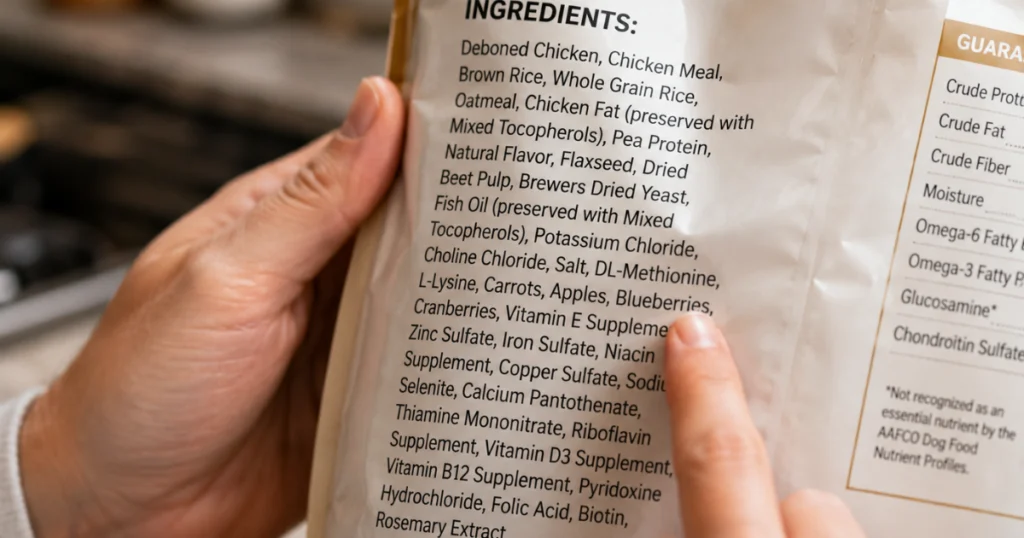
This becomes a skill you develop out of necessity.
Chicken hides everywhere. Chicken meal, chicken fat, chicken liver, poultry meal, poultry by-product — all of these count as chicken exposure for an allergic dog. Even “chicken flavor” can be enough to trigger a reaction in severely allergic dogs.
“Novel protein” on the front doesn’t mean novel protein inside. Some foods marketed as novel protein formulas are manufactured on shared equipment or in the same facility as chicken-based foods, creating cross-contamination. If your dog is severely allergic, look for foods that explicitly state they’re manufactured in dedicated allergen-free facilities — or go with prescription hydrolyzed diets where this is controlled.
Ingredient splitting. Some manufacturers list the same ingredient under multiple names to make it appear lower on the ingredient list. Knowing the alternative names for common allergens is worth the research time.
For building a solid nutritional foundation around your dog’s restrictions, our complete dog nutrition guide covers how to evaluate dog food properly — useful context when you’re trying to find a safe long-term option.
Managing Food Allergies Long-Term
Once you’ve identified the trigger, managing food allergies is actually straightforward — the hard part is the diagnosis.
Stick to the same food. Variety is nice in theory but for allergic dogs, introducing new proteins means introducing new risk. Find a food that works and stay with it.
Be militant about treats. Treats are where most owners accidentally re-expose their allergic dog. Read every label. When in doubt, use a piece of the dog’s own food as a treat — it’s not exciting but it’s safe.
Inform everyone who handles your dog. Dog walkers, boarding facilities, family members, friends who “just want to give him a little something.” Remy wears a tag on his collar that says “chicken allergy” because I learned the hard way that verbal instructions don’t always stick.
Watch for new allergies developing. Dogs with one food allergy are more likely to develop additional ones over time, especially if their immune system remains sensitized. Annual check-ins with your vet are worth it even when things are going well.
Consider supporting gut health. A compromised gut barrier is thought to contribute to food allergy development. Probiotics and omega-3 fatty acids (from a non-allergenic source — fish oil if your dog isn’t fish-allergic) can support overall immune and gut health. See our complete dog nutrition guide for more on these foundational nutrients.
Homemade food as a long-term option. For dogs with multiple food allergies, homemade food gives you total ingredient control. Our homemade dog food recipes can be adapted for allergic dogs — stick to single-protein recipes and swap to whichever protein your dog tolerates. Get a vet review before going fully homemade long-term.
Mistakes I Made That Cost Us Months

Assuming stomach symptoms were required. Remy had no digestive symptoms. I never connected his skin issues to food because of this. If your dog has chronic skin or ear problems with no obvious cause, food should be on the list regardless of whether their stomach seems fine.
Trusting the allergy test results. The saliva test gave me a list of reactive foods that included rice, sweet potato, and carrots — foods that don’t actually cause immune reactions in dogs. I spent months avoiding those foods instead of doing an elimination diet. Wasted time and money.
Not being strict enough on the elimination diet. My first attempt failed because I kept giving Remy his usual treats “just to keep him happy.” There’s no such thing as a partial elimination diet — it either eliminates the allergen completely or it doesn’t work.
Treating symptoms instead of causes. Steroids, antihistamines, medicated shampoo — all of these made Remy more comfortable temporarily, which actually made it harder to identify the pattern. When symptoms are perpetually suppressed by medication, it’s difficult to track what’s actually happening.
Not writing anything down. I kept mental notes for the first few months, which are useless over an 8-week timeline. Download any simple notes app — even the default Notes app on your phone — and log symptoms daily during a food trial. Stool consistency, itch level (1–10), ear condition, paw color. The patterns become very clear when you have actual data.
Switching foods during the trial. When Remy didn’t show dramatic improvement in the first 3 weeks, I switched to a different novel protein food. This reset the trial and cost me another 8 weeks. Once you start, commit to the full duration unless there’s a severe reaction.
When to See a Veterinary Dermatologist
Your regular vet can diagnose and manage most food allergy cases — but there are situations where a specialist is worth it:
- Symptoms are severe (open wounds, significant hair loss, constant secondary infections)
- Multiple elimination diet attempts have failed to identify a clear trigger
- Your dog may have both food allergies and environmental allergies simultaneously (common and complicated to manage)
- You need prescription hydrolyzed protein diets and guidance on which one
Veterinary dermatologists are genuinely different from general practitioners on this topic. My second vet was already much better than the first, but Remy’s follow-up with a dermatologist two months later confirmed everything and gave us a clear long-term management plan.
Frequently Asked Questions
Can dogs develop food allergies suddenly, even to food they’ve eaten for years?
Yes — and this is one of the most confusing aspects of food allergies. Allergies develop through repeated exposure over time, which means a dog can eat chicken for 3 years and then become allergic to it. The immune system builds a response gradually. Sudden onset after years on the same food is completely consistent with how allergies work.
How do I know if it’s a food allergy or seasonal allergies?
Seasonal allergies typically have some variation — worse in spring/summer/fall depending on your region. Food allergies tend to be consistent year-round. That said, many dogs have both, which is why the elimination diet matters — it removes food as a variable regardless of environmental triggers.
Are some dog breeds more prone to food allergies?
Yes. Labrador Retrievers, Golden Retrievers, German Shepherds, Boxers, Cocker Spaniels, Dalmatians, Lhasa Apsos, and West Highland White Terriers are among the breeds with higher rates of food allergies. But any dog of any breed can develop them.
How long does an elimination diet take to show results?
Skin symptoms typically take 6–12 weeks to show meaningful improvement after removing the allergen. Digestive symptoms often improve faster — within 2–4 weeks. Don’t evaluate the trial at 3 weeks and call it failed — full assessment requires the complete 8–12 week period.
Can I use an over-the-counter limited ingredient food or do I need a prescription diet?
OTC limited ingredient foods work for many dogs, but they carry cross-contamination risk from shared manufacturing facilities. For dogs with severe allergies or multiple failed OTC trials, prescription hydrolyzed protein diets (available through your vet) are more reliable. Start with OTC if budget is a concern, and escalate to prescription if it doesn’t work.
My dog tested positive on an allergy blood test — is that reliable?
Blood tests (serum allergy tests) have poor specificity for food allergens — they produce a lot of false positives. Most veterinary dermatologists don’t rely on them for food allergy diagnosis and use them primarily for environmental allergens. The elimination diet is the only validated diagnostic method for food allergies.
What if my dog is allergic to multiple proteins?
It happens — especially in dogs who’ve been sensitized for a long time. The elimination diet can still help by starting from a completely clean slate and reintroducing proteins one at a time. Some dogs end up on very restricted diets or hydrolyzed protein food long-term. It’s manageable — it just requires more vigilance with labels.
Can puppies have food allergies?
Yes, though it’s less common than in adult dogs simply because they haven’t had as much exposure time to develop a sensitization. Most food allergies present in dogs between 1 and 3 years old, but puppies and senior dogs can develop them too.
Will my dog need to avoid the allergen forever?
In most cases, yes. Food allergies don’t go away the way some environmental allergies can diminish over time with immunotherapy. Once identified, the safest long-term approach is permanent avoidance of the triggering protein. The good news is that most dogs with food allergies thrive perfectly well on an allergen-free diet — Remy has been on his venison-based food for 14 months and is the healthiest he’s ever been.
Is there any treatment other than dietary management?
Medications like Apoquel and Cytopoint can manage allergic itch symptoms and are sometimes used alongside dietary management, especially when both food and environmental allergies are present. But for food allergies specifically, avoidance of the trigger is the only thing that addresses the root cause. Medication manages symptoms — it doesn’t fix what’s causing them.
What Changed for Remy

Fourteen months on a venison and sweet potato diet. No ear infections. No 2am scratching. No raw pink paws.
His coat is the best it’s looked since he was a puppy. He sleeps through the night. He’s visibly more comfortable in his own skin — which sounds like an exaggeration until you’ve watched a dog be chronically uncomfortable for months and then watched them stop.
The diagnosis wasn’t dramatic. There was no single test, no lightbulb moment. Just a vet who asked the right question, a tedious 10-week food trial, and the realization that the answer had been in his food bowl all along.
If your dog is stuck in the same loop — the itching, the ear infections, the treatments that work and then wear off — food is worth investigating seriously. It’s not always the answer. But when it is, the fix is straightforward, permanent, and completely worth the effort.
And if you’re building out your overall understanding of what your dog actually needs nutritionally, our best dog food for sensitive stomach guide covers the overlap between sensitivities and allergies, and our top 5 healthiest dog foods review highlights options with clean, traceable ingredients that work well for dogs with dietary restrictions.